The
InterviewErik
Blachford
The former CEO of Expedia on investing in what matters, and why not all dividends are financial.
Photographs
Courtesy: Erik Blachford
In 2022, Erik Blachford was at a crossroads, trying to figure out his next step. Then, that fall, his son suffered a horrific bike accident that led to over a year and a half in various hospitals. Suddenly, musing about board meetings or early-stage startups gave way to bedside hand-wringing. The former Expedia CEO, venture capitalist, and endurance athlete initially felt unable to do much of anything.
As his son’s condition improved, though, Erik began to reassess what mattered to him. “I thought, ‘I want to do something different’. I want to go deeper on fewer things that I actually care about.” He found himself turning back to the throughlines in his personal and professional life: the outdoors and travel.
Erik talks to us about his passion for the outdoors and bringing its benefits to more people. He shares what it’s like to pivot in your late 50s, reassuring us that it’s not too late to set new goals. As if to prove it, last spring Erik completed his third Ironman, over a decade after his last one.
Above: Erik canoeing on the Snake River in the Yukon Territory, Canada, with family members in the summer of 2025.
“If I’m helping people spend more time outdoors with other people—not on screens, not interacting with artificial intelligence—that feels worthwhile.”
Noelle Salmi: For people who don’t know your story, can you kind of recap the basic outline?
Erik Blachford: I know you’re doing “Seconds,” but there’s kind of three acts here. The first act was corporate or business operation, where I did everything from the Expedia startup team, through when I was the CMO, and then I was the CEO. And then I ran TerraPass, and then I ran Butterfield & Robinson, and so those were all hands-on: CEO, managing people, managing the businesses.
And then the second phase was partly investment with TCV. I was a venture partner for eight years and, at the same time, I was doing my MFA in creative writing at San Francisco State. TCV was late stage investing, and I was also doing a bunch of early stage investing on my own. They didn’t conflict, so it was a nice situation. That kind of wound down coincident with the pandemic, where just the world changed. And then, well, the third chapter is, this is where things get sort of crazy.
NS: It was a challenging time.
EB: I walked the Camino de Santiago in Spain, and I was like, what am I going to do next? I had divorced, I’m contemplating the whole thing, and then my son Ari had his accident. This was the fall of 22, which is almost four years ago now, and so then all of a sudden he spends a year and a half in and out of hospitals, including four months in Boston. There’s this weird feeling when you’re a caregiver, you sort of feel like, since that’s your primary role, you’re almost not supposed to put time into other stuff.
Then Ari got to the point where it became clear that he wasn’t going to be in the hospital anymore, and he was going to be more in therapeutic settings, and now he’s in community college. So 2024 was the first time when I was looking around. I was like, I’m in my late 50s and I’m kind of stalled… but my son is getting better, so that’s important.
NS: You were ready for a third phase?
EB: I thought, ‘do I really want to sit around talking to a bunch of founders who I’m probably not going to fund?’ Because you only fund one out of 100 of these things anyway. I wanted to do something different. I want to spend time with a smaller number of companies, but also organizations; it doesn’t have to be some startup thing. And I want to put time into advising. I want to be on boards. I want to go deeper on fewer things that I actually care about.
I went from kind of chasing whatever seemed to make sense from a financial return point of view at TCV, which is what you do in those situations, to the outdoor world. I had bought Camp Nominingue [a boys’ summer camp in Quebec] in 2015, and so that was one part. I joined the board of Hipcamp, which is sort of the Airbnb for outdoor private lands. And I’m the chairman at the Adventure Travel Trade Association and chairman also at Terra Mobility, which is sort of around-the-world bus travel. And I decided to recommit into the travel industry, and that led me into a new kind of portfolio of stuff.
NS: Tell me why the outdoor space in particular is a passion for you.
EB: There’s two parts. One is just, it’s back to my roots. Growing up in Montreal, spending weekends at the cabin with the family, and spending all my summers at summer camp, and I was staff there. My first job was a bike tour guide in Europe. I just really like being outdoors. I like being connected with that. And the notion that I can spend a bunch of time helping other people get outdoors and feel the same thing, that also feels really good.
Having just come off a family camp at Camp Nominingue, the other part of it that I appreciate now is, when you’re outdoors, you’re actually connecting with other people. If I’m helping people spend more time outdoors with other people—not on screens, not interacting with artificial intelligence—that feels worthwhile. It feels like a good thing to do. It just feels like an investment of time that pays off the right dividends. Dividends are not all financial.
“If you’re 50 or anywhere in your 50s, there’s still tons of time to course-correct into something that gives you more satisfaction on a day-to-day level.”
NS: Besides the outdoors, another throughline for you has been endurance sports. You just finished another Ironman. Why do you do it?
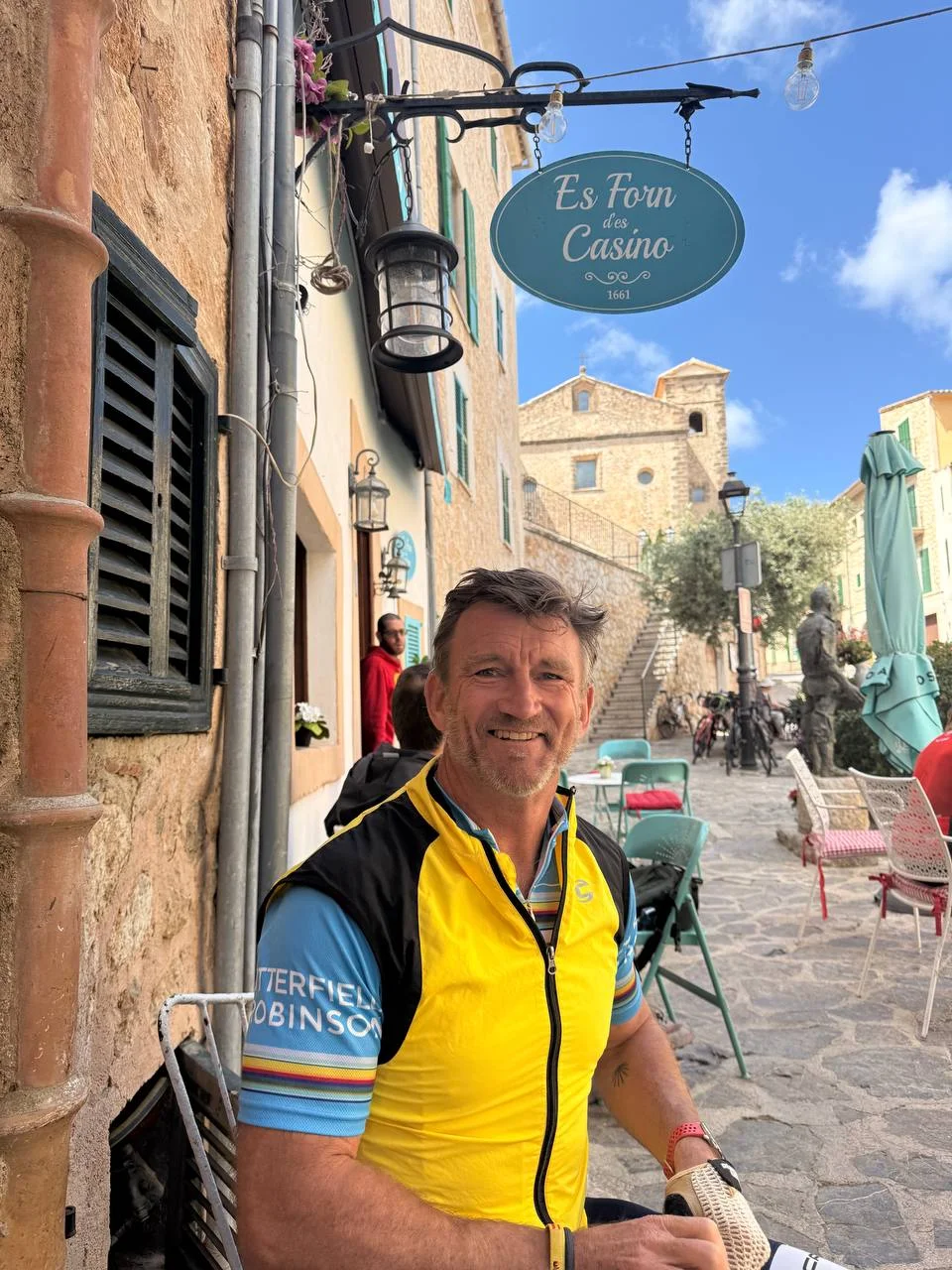
EB: So the first endurance thing I did was the New York Marathon back in 1995. I was just wanting a goal, something to train for, to keep me fit. If you’re the kind of person who does a marathon, and then Canadian ski marathons, next thing you know, you’re into biking and then triathlons. A certain personality type has to end up doing an Ironman. My first round back in 2003 was that, and then I did another one in 2013. In fact, I was faster in my 40s than I had been in my 30s.
Coming back to it in 2026, I really wanted to push myself and be in touch with the physicality of it, because the thing about endurance sports is you can’t escape yourself when you’re doing those things. You can’t do an Ironman without training for it. I like the training, and I like the notion of really having to do something that is completely non-cerebral, other than tracking your time or whatever.
Having spent all the time I’d spent in hospitals, cheering for my son, just out of my head, it’s incredibly satisfying to say, I’m just going to do something that’s right here. It’s the thing that I can kind of control. It’s one of those things where it feels like there is a very direct throughline to what you get out of it.
NS: Looking back at the first two stages, is there something you would like to go back and tell yourself?
EB: I enjoyed doing the investing thing, and I certainly enjoyed joining my MFA. It was fun. It was a worthwhile thing to do. I feel like between those two things and having a very active social world, having the kids the age they were, I do wish that I’d been a little more present and done a little less. I didn’t need to go to Burning Man every single year.
I’ll give you an example. I joined a board, an ed tech company. It was a good board, it was consumer facing, I was happy to do it. Except that it was in St. Louis, and there are no direct flights, so every single board meeting, four times a year, you had to spend two nights minimum in St. Louis… And I was on a board in Sydney where I would fly overnight, do the board meeting, and fly overnight back sometimes.
I look back and think I was just caught up in something. I think it happens to a lot of people. Travel starts to become a bit of a lifestyle. And that creeps up on you. That’s time you’re not spending with your kids. It’s unhealthy. I have a little regret about letting myself get caught up in that stuff, and I certainly feel like, moving forward, I’m very intentional now about the boards that I take on.